
verified-scientific-illustration
@randalolson/verified-scientific-illustrationSafety
Runnable
Well-formed
Use when you want a publication-ready labeled scientific or anatomical diagram - a heart, a cell, a neuron, the water cycle, an engine cutaway - and need every label, part count, and relationship checked against a fact sheet you control before it ships, so a figure with a misspelled label, a wrong count, or a made-up part never lands in a slide, worksheet, or textbook.
See it in action
Ask an image model for a labeled scientific diagram and it hands back a confident, authoritative-looking figure in seconds that gets the science wrong. The water cycle below looks finished, every stage named and in place, and the arrow labeled evaporation points down, out of the sky into the ocean, the opposite of what evaporation is. It looks right, so it ships, and a student copies a cycle that runs the wrong way. This workflow checks every label and every relationship in the figure against a fact sheet you write, regenerating when a check fails, so only a figure whose facts hold gets through. Commissioning a figure like this by hand runs hundreds of dollars, which is why people reach for the model in the first place. Fork it and run it on your own subjects.
How it works
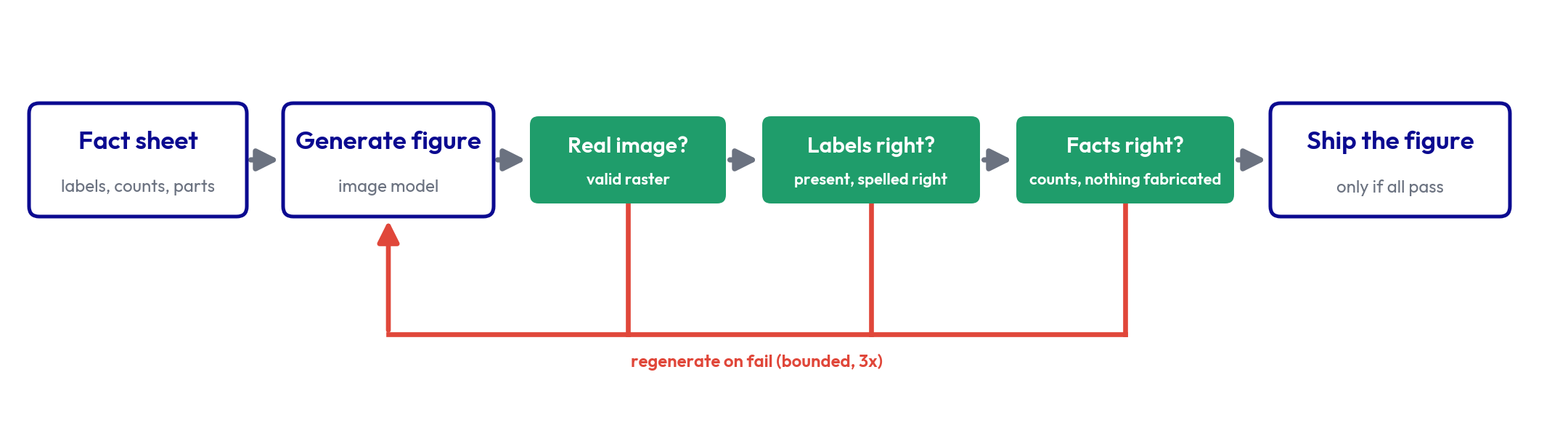
You write a short fact sheet for the subject. It lists the labels a correct figure must carry, the counts, the relationships that have to hold, and anything that must not appear. The workflow generates the figure and runs two checks on it. One confirms that every required label is present and spelled correctly. The other confirms that the counts and relationships match your fact sheet, with nothing reversed or fabricated. Two deterministic guardrails sit around those, so the fact sheet has to be well formed before a generation is spent, and the output has to be a real image. A figure ships only when it clears every check. One failure blocks it, and the workflow regenerates with the failure fed back in, flagging the figure only if it still misses after a few tries.
The facts it has to honor
For this diagram, the fact sheet says the water cycle runs in one direction. Evaporation rises from the surface into the air, condensation forms clouds as that vapor cools, precipitation falls from the clouds to the ground, and collection returns the water to oceans, lakes, and rivers. The four core stages must all be present and correctly placed, and the sun is shown as the energy source. Extra real stages like transpiration, infiltration, and runoff are fine. The figure must not draw evaporation falling, precipitation rising, any stage arrow pointing the wrong way for its label, or any invented or misspelled stage. That is the contract the figure has to meet.
Without the workflow
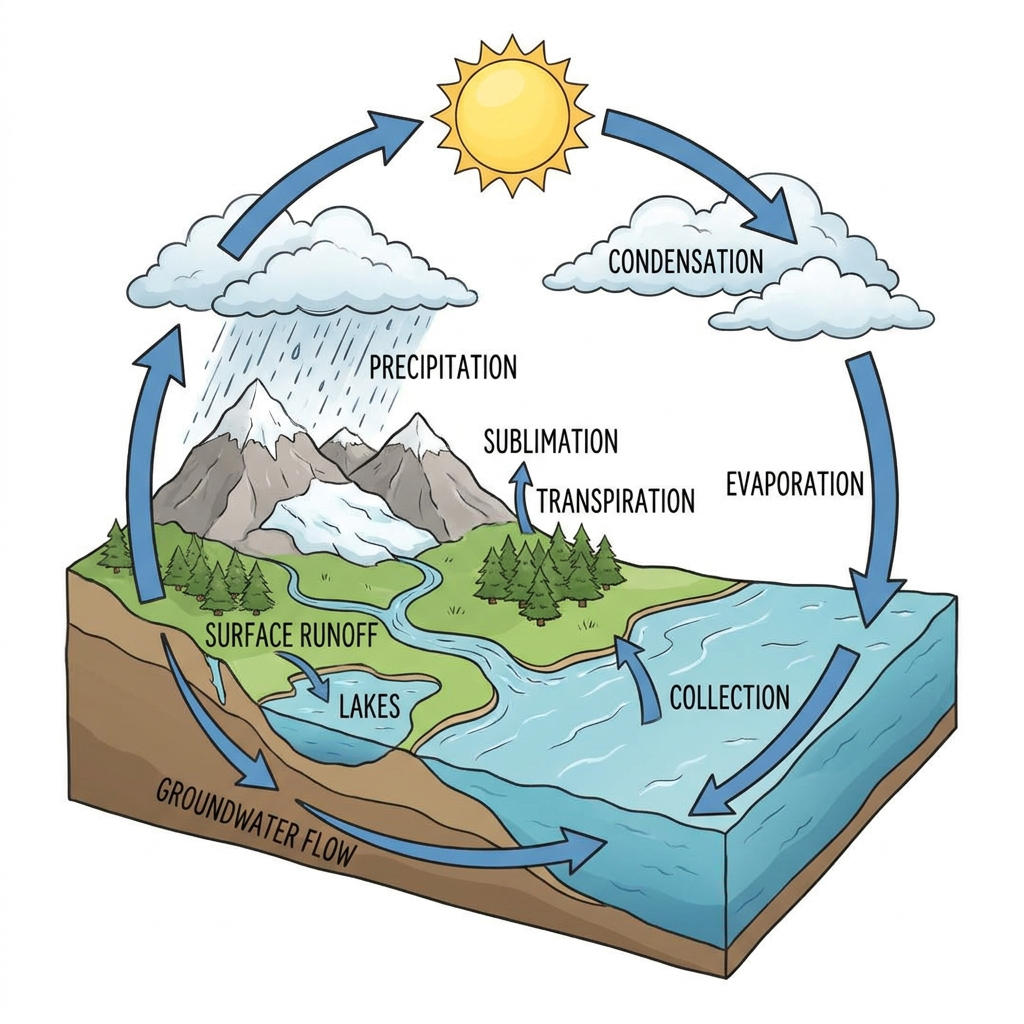
"A detailed, labeled scientific diagram of the water cycle," one plain request, no checking. Every stage is named and in place, so the figure reads as a finished textbook plate. Now trace the arrows. The one labeled evaporation points down, out of the sky and into the ocean, the opposite of what evaporation is. That is the kind of error that ships when a figure already looks authoritative, and the fact check, matching the diagram against your ground truth, is what catches it.
With the workflow
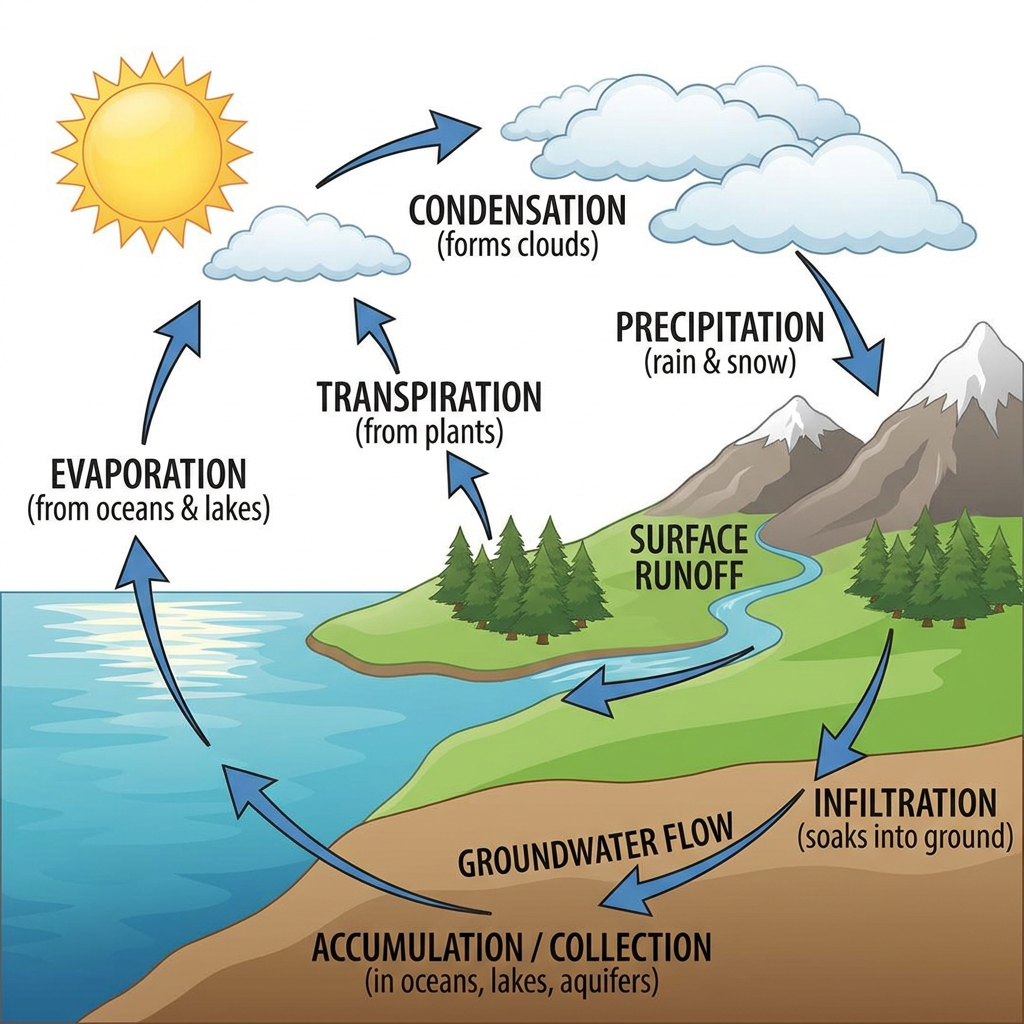
Same image model, same plain request. These two figures are independent draws from that one prompt, not a regeneration of a single picture. Image models swing from run to run, in style and in substance, so one draw put evaporation backwards and another got it right. The workflow does not pick the better-looking image, it checks each draw against your fact sheet and ships only one whose facts hold. Both come from the bare request here on purpose, to isolate the one variable that matters, the check. In normal use the workflow also builds the prompt from your fact sheet and feeds each failure back, so it usually corrects the figure rather than waiting for a clean draw. This one passed. Evaporation rises from the water, condensation forms the clouds, precipitation falls to the ground, collection carries the water back, every stage in place and pointing the right way.
What this workflow checks
In a dense labeled figure a single wrong arrow, a fabricated stage, or an off count looks as authoritative as everything around it. Checking every figure against your fact sheet is what keeps the wrong one from shipping when you cannot trace every arrow by eye.
Build your own
Fork this template, write the fact sheet for your subject, a cycle, an anatomy plate, a periodic table, an engine cutaway, an org chart, and run it. Every figure comes back with the label and fact checks attached.
Use this template
Your agent fetches this runbook and runs it, revising the output until the verifiers pass.
First time with Goodeye?
Connect your agent over MCP, then ask it to fetch this template by its identifier. Or install the CLI and run the command below.
claude mcp add --transport http goodeye https://mcp.goodeye.dev/mcpuv tool install goodeyeConnecting over MCP prompts a quick sign-in. The CLI can fetch and run a public template with no account.
Fetch or fork
goodeye templates get @randalolson/verified-scientific-illustrationgoodeye templates fork @randalolson/verified-scientific-illustrationAlso available from
get_template(identifier="@randalolson/verified-scientific-illustration")curl https://api.goodeye.dev/v1/templates/@randalolson/verified-scientific-illustration